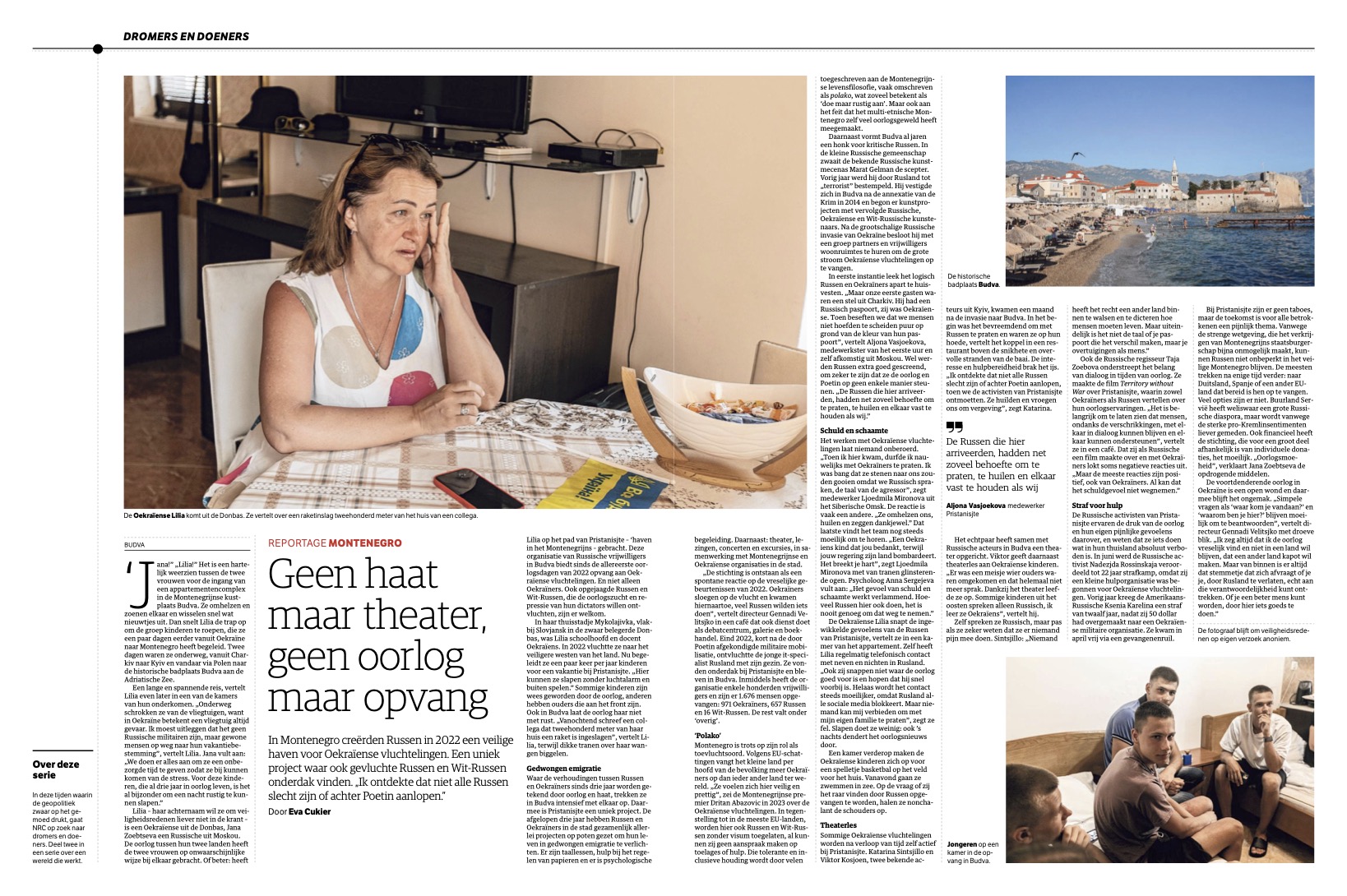
An article about the Pristanište foundation was published in the Dutch media outlet NRC.
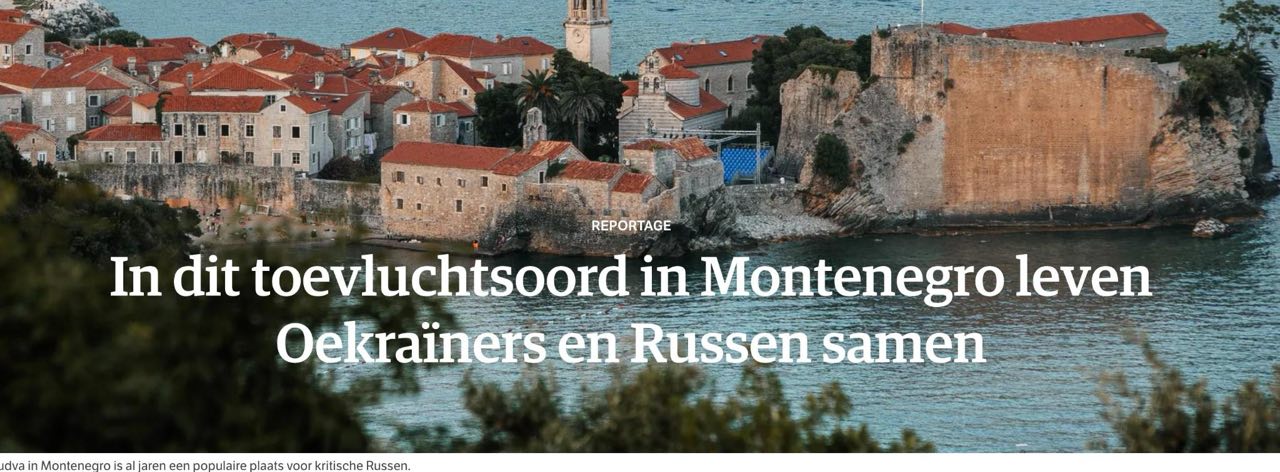
“Yana!” “Lilia!” It’s a warm reunion between the two women at the entrance of an apartment building in the Montenegrin coastal town of Budva. They hug, kiss, and quickly exchange news. Then Lilia hurries upstairs to call the group of children whom she had accompanied from Ukraine to Montenegro a few days earlier. They had spent two days traveling, from Kharkiv to Kyiv and from there via Poland to the historic resort town of Budva on the Adriatic Sea.
It was a long and tense journey, Lilia says later in one of the rooms of their shelter. “Along the way they were scared of airplanes, because in Ukraine an airplane always means danger. I had to explain that these aren’t Russian military aircraft, but ordinary people on their way to a holiday destination,” Lilia says. Yana adds: “We do everything possible to give them a carefree time so they can recover from the stress. For these children, who have lived in war for three years, it’s already something special just to sleep through the night peacefully.”
Lilia – she prefers not to share her last name for safety reasons – is a Ukrainian from Donbas, and Jana Zubtseva is a Russian from Moscow. The war between their two countries brought these two women together in an unlikely way. Or rather: it brought Lilia to Pristanishte — “harbor” in Montenegrin. This organization, run by Russian volunteers in Budva, has been offering shelter to Ukrainian refugees since the very first days of the war in 2022. And not only Ukrainians: persecuted Russians and Belarusians fleeing the warmongering and repression of their dictators are welcome as well.
In her hometown of Mykolajivka, near Sloviansk in the heavily besieged Donbas, Lilia was a school principal and a Ukrainian language teacher. In 2022 she fled to the safer west of the country. Now, several times a year, she accompanies groups of children for a vacation at Pristanishte. “Here they can sleep without air raid alarms and play outside.” Some of the children have been orphaned by the war, others have parents fighting at the front. Even in Budva the war continues to follow her. “This morning a colleague wrote that a rocket landed two hundred meters from her house,” Lilia says, as thick tears roll down her cheeks.
Forced migration
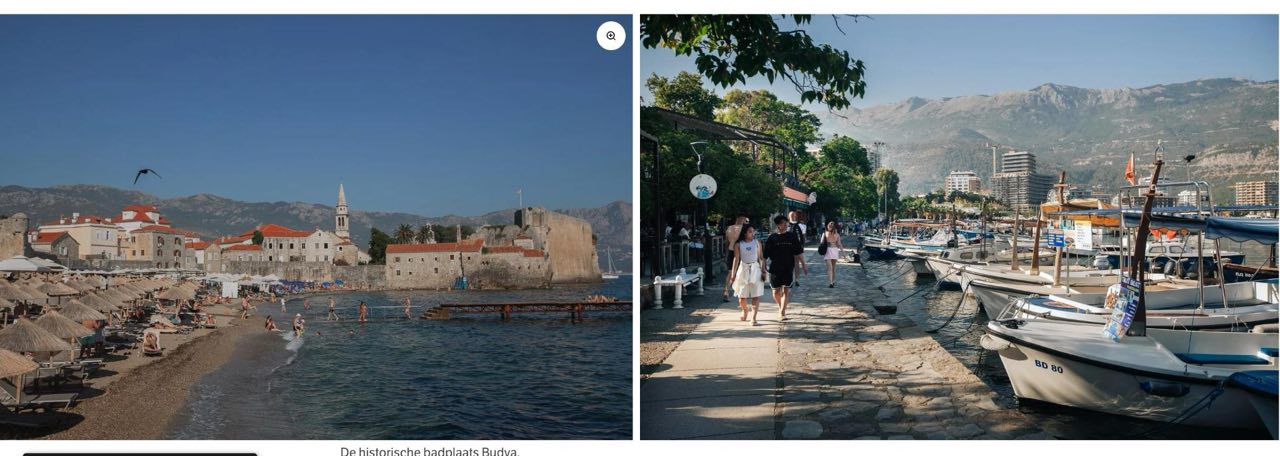
Where relations between Russians and Ukrainians have been dominated by war and hatred for the past three years, in Budva they interact closely. This makes Pristanishte a unique project. Over the past three years, Russians and Ukrainians in the city have jointly set up various projects to ease life in forced emigration. There are language classes, assistance with paperwork, and psychological support. And beyond that: theater, lectures, concerts, and excursions, in cooperation with Montenegrin and Ukrainian organizations in the city.
“The foundation arose as a spontaneous reaction to the horrific events of 2022. Ukrainians fled and came here, and many Russians wanted to help,” says director Gennadi Velitsjko in a café that also serves as a debate center, gallery, and bookshop. At the end of 2022, shortly after Putin announced mobilization, the young IT specialist fled Russia with his family. They found shelter at Pristanishte and stayed in Budva. The organization now has several hundred volunteers and has sheltered 1,676 people: 971 Ukrainians, 657 Russians, and 16 Belarusians. The rest fall under “other.”
“Polako”
Montenegro is proud of its role as a sanctuary. According to EU estimates, the small country hosts more Ukrainians per capita than any other country in the world. “They feel safe and comfortable here,” Montenegrin prime minister Dritan Abazović said in 2023 about Ukrainian refugees. Unlike most EU countries, Montenegro also allows Russians and Belarusians to enter without a visa, though they are not eligible for allowances or government support. This tolerant and inclusive attitude is often attributed to the Montenegrin philosophy polako, meaning “take it easy.” But also to the fact that multi-ethnic Montenegro has itself experienced much wartime violence.
“The Russians who came here needed just as much to talk, to cry, to hold each other” — Aljona Vasjokova, Pristanishte staff member.
Budva has long been a home for critical Russians. In the small Russian community, well-known Russian art patron Marat Gelman plays a leading role. Last year he was designated a “terrorist” by Russia. He settled in Budva after the annexation of Crimea in 2014 and began art projects with persecuted Russian, Ukrainian, and Belarusian artists. After the large-scale invasion of Ukraine, he and a group of partners and volunteers began renting housing to accommodate the growing flow of Ukrainian refugees.
Initially, it seemed logical to house Russians and Ukrainians separately. “But our first guests were a couple from Kharkiv. He had a Russian passport, she a Ukrainian one. Then we realized that we didn’t need to separate people solely based on the color of their passport,” says employee Aljona Vasjokova, originally from Moscow. Russians, however, were screened extra carefully to ensure they did not support the war or Putin in any way. “The Russians who arrived here needed just as much to talk, to cry, and to hold each other.”
Guilt and shame
Working with Ukrainian refugees leaves no one untouched. “When I first came here, I hardly dared to speak to Ukrainians. I was afraid they would throw stones at us because we speak Russian, the language of the aggressor,” says staff member Lyudmila Mironova from Omsk in Siberia. But the response was often different: “They hug us, cry, and say thank you.” Hearing that remains difficult for the team. “A Ukrainian child thanking you while your government is bombing their country… it breaks your heart,” Mironova says, tears in her eyes. Psychologist Anna Sergeyeva adds: “The feeling of guilt and shame is paralyzing. No matter how much Russians here do, it will never be enough to take that away.”
Lilia understands the complicated feelings of the Russians at Pristanishte, she says in one of the rooms of the apartment building. She regularly keeps in touch with cousins in Russia. “They also don’t understand what the war is for and hope it ends soon. Unfortunately, contact is getting harder because Russia blocks all social media. But no one can forbid me to talk to my own family,” she says sharply. She sleeps little: even at night the news of the war keeps coming.
In the next room, the Ukrainian children are getting ready for a game of basketball outside. Tonight they’ll go swimming in the sea. Asked whether they find it strange to be hosted by Russians, they shrug casually.
Theater class
Some Ukrainian refugees later become active at Pristanishte themselves. Kateryna Sinchylo and Viktor Kosyun, two well-known actors from Kyiv, arrived in Budva a month after the invasion. At first it felt strange to talk to Russians, and they were cautious, the couple says in a restaurant above the scorching, crowded beaches. But the interest and willingness to help broke the ice. “I discovered that not all Russians are bad or follow Putin, when we met the activists of Pristanishte. They cried and asked us for forgiveness,” Kateryna says.
The couple founded a theater in Budva together with Russian actors. Viktor also teaches theater classes to Ukrainian children. “There was a girl whose parents had been killed and who no longer spoke at all. Thanks to theater, she came back to life. Some children from the east only speak Russian, so I teach them Ukrainian,” he says.
They themselves speak Russian, but only when they’re sure it won’t hurt anyone. Sinchylo says: “No one has the right to invade another country and dictate how people should live. But in the end, it’s not the language or passport that matters, but your convictions as a person.”
Russian film director Taya Zubova also emphasizes the importance of dialogue in times of war. She made the documentary Territory Without War about Pristanishte, in which both Ukrainians and Russians talk about their wartime experiences. “It’s important to show that despite the horrors, people can remain in dialogue and support each other,” she says in a café. As a Russian who made a film with and about Ukrainians, she sometimes receives negative reactions. “But most reactions are positive, including from Ukrainians. Though that doesn’t take away the feeling of guilt.”
Punishment for helping
The Russian activists at Pristanishte feel the pressure of the war and their own painful emotions, and they know they’re doing something absolutely forbidden in their homeland. In June, Russian activist Nadezhda Rossinskaya was sentenced to 22 years in a penal colony because she had started a small aid organization for Ukrainian refugees. Last year, American-Russian Ksenia Karelina received a twelve-year sentence after donating 50 dollars to a Ukrainian military organization. She was released in April in a prisoner exchange.
At Pristanishte nothing is taboo, but the future is a painful topic for everyone involved. Due to strict laws that make it almost impossible to gain Montenegrin citizenship, Russians cannot stay indefinitely in safe Montenegro. Most eventually move on: to Germany, Spain, or another EU country willing to take them in. Options are limited. Neighboring Serbia has a large Russian diaspora, but is often avoided due to strong pro-Kremlin sentiment. Financially the foundation is also struggling, as it relies heavily on individual donations. “War fatigue,” explains Jana Zubtseva, referring to dwindling funds.
The ongoing war in Ukraine is an open wound, and with it remains the discomfort. “Simple questions like ‘Where are you from?’ and ‘Why are you here?’ are still hard to answer,” says director Gennadi Velitsjko with a sad look. “I always say that I think the war is horrible and that I don’t want to stay in a country that wants to destroy another one. But deep inside there is always that voice asking whether by leaving Russia you can really escape responsibility — and whether you can become a better person by doing something good here.”