

I’m a Montenegrin, but I didn’t think about it until I was 15.
We all lived in the same country, Yugoslavia. I was born in Belgrade, and I also finished high school in Serbia. But my father and mother were originally from the Montenegrin village of Lutovo, and, for example, some words were pronounced in the Montenegrin way. They said “ovje”, and I, like most of my classmates, “ovde”, in Serbian. My parents didn’t correct me, and I didn’t correct them. Every summer we went to their native Lutovo, and to Podgorica, where they were building a house, and in general all over Montenegro-Kotor, the Old Town, Cetinje, the palace of King Nikola, the monastery… I took this small mountain land as my own. But I didn’t feel like a stranger in Belgrade either.
We stopped in Croatia, in the city of Karlovic. And suddenly my classmates on the bus jumped up from their seats, began to show passers-by the middle finger and shout: “This is Serbia, this is Serbia!” Then we stayed in a hotel near the city of Rijeka, and there they rushed to paint the walls with Serbian national symbols. All this was strange, surprising, and alien to me. I think that was the first time I thought: no, I’m not with them. I’m not a Serb, I’m a Montenegrin.
When I entered the university, Belgrade was a cosmopolitan multicultural city: many foreigners, students from Asia, Africa, and South America. But the idea that the Serbs had lost a lot in Yugoslavia was already gaining popularity, that Serbia’s fate would have been better without Yugoslavia, and that it would have been necessary to restore a large Serbian state. They talked about it on TV, staged plays, and wrote books. They tried to draw me into some Serbian nationalist student circles and communities, but I was not enthusiastic about it. My fellow Croat students packed their bags, dropped out of school, and left for Croatia. The air already smelled strongly of the collapse of Yugoslavia. But we didn’t know it would be so bloody yet.
And in 1991, the war began. We students went out to anti-war protests. But if the authorities want blood, no amount of protests will stop it. And Belgrade lost its multiculturalism and became a provincial city. My dad was seriously ill at the time. He asked for: “Just don’t bury me in this Serbian mud. Take me to Lutovo.”
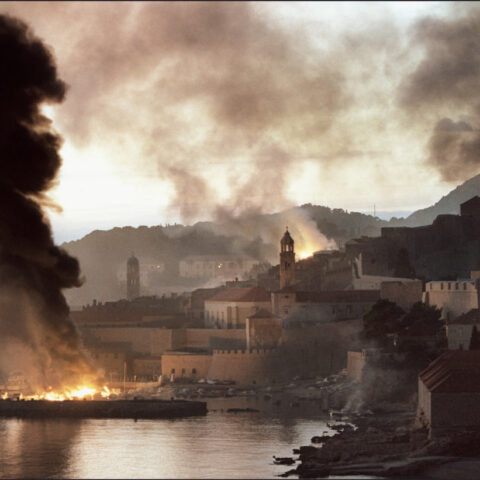
So my identity was shaped by Serbian nationalism. I became a Montenegrin because the Serbs became aggressively Serb. “We need a big state, and we will get it through war,”the agenda was adopted. In Montenegro, however, many people also supported her. When Dubrovnik was attacked, I watched in horror as people in Podgorica enthusiastically gathered to fight for the Serbs against the Croats. And I didn’t understand how you can enjoy aggression and death.
Maybe that’s also why I understand the anti-war Russians who are now in Montenegro very well. You, like me, cannot accept that many of your compatriots in Russia support the attack on Kiev. And the way your church behaves in justifying the war is not surprising to me. So did the Serbian Church. So I separated myself from the church. Ancient monasteries-yes, they are, let’s say, saints. But what is happening in the Serbian Church now is far from holy.
There was no military action in Montenegro itself in the 1990s. But the war was felt – through the collapse of the economy, rapid impoverishment, wild inflation, sanctions. The borders were closed. No medication was received. Electricity was cut off every day for 6-7 hours. Our athletes couldn’t go to competitions, and our actors couldn’t go to shootings. And the most difficult thing is the feeling of rejection, cut off from the world. Russians now suffer from being issued European visas only for the duration of their trip. I know that, too. We were practically not issued any visas at all. Someone somehow got, but-kilometer queues in front of embassies, sometimes passports were simply thrown in people’s faces.
…Once, when I was going to enter the Faculty of Philology, I chose between the Russian department and the Italian one. I chose Russian, and my father supported me. He was taught Russian at school by an old teacher, probably from your white emigration. My father often talked about it. Everything Russian in our family was close. So I easily immersed myself in the Russian language. I read all your classics, studied history, made friends with Russians, and even had a Russian wife. Now I sometimes talk to my friends, Montenegrins and Serbs, who know almost nothing about Russia, but support Russia in the war with Ukraine. I tell them: “You don’t love Russia. You love power and the fact that Russia has nuclear weapons.” But I love Russia, and I take its tragedy as my own.
I have a feeling that this is almost my country this is how it behaves. Almost my country is once again killing people. Almost my country today again dropped a bomb on a residential building in Kiev. Do you know what it’s like? When a person you love very much suddenly does something monstrous. And you’re so painfully ashamed of it that you get depressed.
And the people from Pristanište gave me an important trump card. When I talk to Montenegrins or Serbs who are sure that all Russians are for the war, I say: “No, not all of them. I personally know those who are against it.” They say: “All Russia is for Putin!” And I say: “97 % of Russians who voted in Montenegro voted against Putin.” And you know, there are people who really think about it and change their point of view. Of course, it is not your direct responsibility to form in the minds of Montenegrins the idea that there is another, not Putin’s Russia. But you do it indirectly, simply because you are there.
I still have friends from my childhood and youth in Serbia. We sometimes gather in our small town where we once studied. But we don’t talk about politics. Sounds familiar, right? I also lost my family, like many of you. My blood relatives stayed in Serbia. They now define themselves as Serbs and treat me with coldness. For them, I am a “stranger”, “dissident”, “foreign agent”. Oh, well.
I am glad that Pristanište was formed in Montenegro. In general, I am glad that families where the husband, for example, is Russian and the wife is from Ukraine feel normal here. I have many such students. And no one reproaches him or her that the passport is the wrong color, or the accent is not the same. Montenegro should be like this-small, friendly and open. This is her chance to become strong. It will survive only as a multicultural, multi-confessional country, where people respect the right of others to be different. Otherwise, it will become a Serbian province. I would really hate that.
I am currently studying Ukrainian. I want to razmovlyati Ukrainian movoy. I plan to go to Ukraine, I hope it will work out soon. I want to help the Ukrainians. And I will continue to help Russians who do not agree with the war.
Interview recorded