

I was born in Sverdlovsk, but I am a Serbian citizen and have lived in the Balkans since I was 17. This happened as a result of historical twists and turns and spy adventures involving my ancestors. My maternal grandfather’s family lived in Croatia. In the 1920s, two young men — my grandfather and his brother — got mixed up with local communists. Communism was fashionable then; it was cool, progressive, and unsafe. To avoid trouble with the Croatian royal police, my great-grandmother took her sons to Paris. There, both were recruited by Soviet military intelligence (the GRU). The brother went on assignment to Japan, became part of the Sorge group, and died in a Japanese prison. My grandfather married my grandmother — a Polish Jewish woman — in Paris, after which he was sent by the GRU, of course, to another European country. In 1940 he died, and the Soviet government evacuated my grandmother and her two daughters to Sverdlovsk.
Almost 20 years later, in the late 1950s, a young Serbian man came there from Yugoslavia for an internship — my future father. He met my mother. I was born.
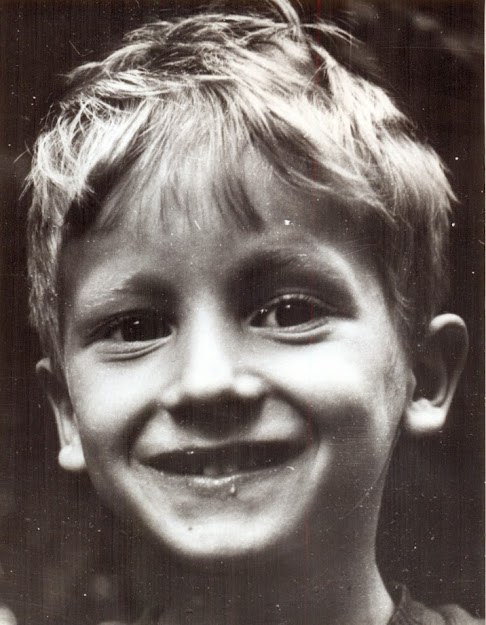
.
My mother’s family spoke Russian. My father’s family, naturally, Serbian. Every summer I traveled from Sverdlovsk to Belgrade for school holidays, to my grandparents. I learned Serbian by myself, from comic books — never attended a language course. But more importantly, here in the Balkans I learned to live and think freely, outside the Soviet mindset. Yugoslavia was, of course, a socialist country, but not the “Sovok.” At the very least, its borders were open — you could travel around most of Europe.
At 16 I was summoned to the Sverdlovsk “organs,” the KGB. If there is anything that never changes, it’s the address of the office: Lenin Street 17. I suspect the tsarist secret police was housed there too. Now, naturally, it is the FSB office. They politely asked me: “Boy, which citizenship will you take — your mother’s or your father’s?” I didn’t hesitate for a second. A year later, after finishing school, I entered the Faculty of Law at the University of Belgrade. When asked to describe in one sentence what changed in my life after leaving the USSR, I answer: “I started buying Time magazine at a kiosk.”
While studying law, I began working for the Russian-language editorial team at Radio Yugoslavia — something like the BBC Russian Service, but in the Balkans. They hired me because I spoke Russian fluently. Later, even while working as a lawyer, I collaborated with them for about 10 more years. After the political shift in Russia, I also wrote for Nezavisimaya Gazeta — they contacted me whenever something urgent happened in the Balkans.
I watched the Yugoslav war unfold with my own eyes. In some sense it resembled what is happening now with Russia: the political situation gradually worsened and worsened, but everyone thought things wouldn’t go all the way. That’s why in 2014, when Russia annexed Crimea and provoked unrest in Ukraine’s eastern regions, I had the feeling that Russia was following a “manual” written in Yugoslavia during the 1990s–2000s. When a dictator emerges in any country and subjugates the people, the future becomes easy to predict. Events unfold according to the same script and end in war. That’s how it was in 1930s Germany, how it was in Yugoslavia — thankfully without gas chambers — and that is what is happening in Russia today. The same looting and lawlessness disguised as patriotism. And it always ends badly for everyone, but above all — for the people and the country that allowed its dictators to do this. There are no exceptions.
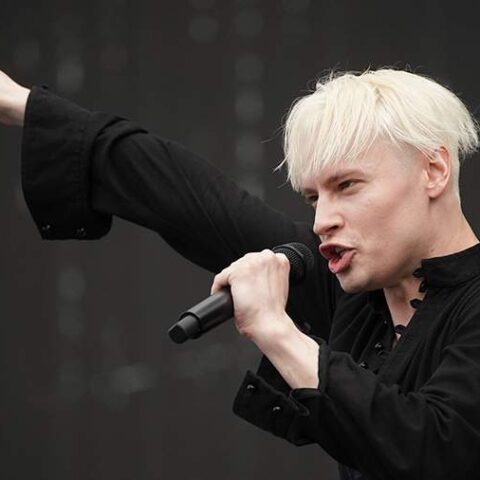
Recently someone pointed out how much the image of the Russian singer Shaman, Putin’s favorite, resembles the image of the young Nazi boy in Bob Fosse’s film Cabaret. I don’t think it’s intentional copying. I’m sure it’s not. Rather, it’s a historical pattern: if you follow the same ideological path, you end up with the same visual image, the same way of thinking, the same behavior.
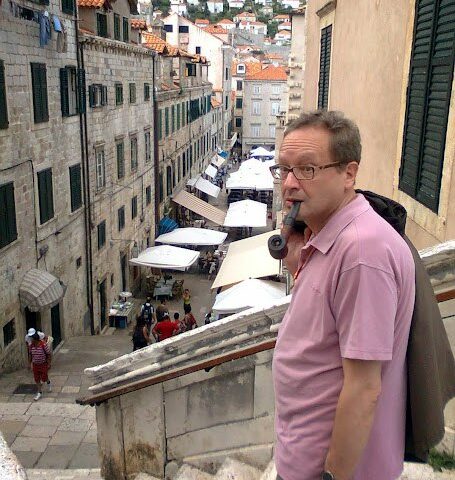
I’ve lived in Montenegro for almost 18 years. I can’t say that I love Montenegro more and Serbia less, or vice versa. In both places, I love specific things. I love Belgrade for its atmosphere — it has a unique “Belgrade spirit.” I love Serbian medieval monasteries — anyone on the Balkans should visit them; the frescoes are stunning. For example, the Mileševa Monastery, right on the Serbo-Montenegrin border in Prijepolje. And take a drive from Belgrade along the Danube to the Iron Gates — along the Romanian border, the scenery is breathtaking. What do I love in Montenegro? You can see it on my Facebook page. It’s full of Montenegrin photos — a sort of chronicle of everyday life here. Since age nine, when I was gifted a Smena camera, I’ve loved photography. I photographed everything that impressed, surprised, or moved me. Later I cooled off a bit. With smartphones, it all came back.
I became a Pristaniste volunteer because in March 2022 I felt that I had to do something. In Podgorica, right after the invasion, people organized a rally in support of Ukraine. I got on a bus from Herceg Novi and went to that rally — it was a completely natural impulse. Then I began reading Serbian newspapers. I was shocked at how pro-Putin some of them portrayed the events. And many people supported Russia based on the doctrine: “Everything Putin does is right.” For Serbian audiences (in the magazine Vreme) I began explaining what was really happening in Russia and to Russians, what the Russian press was writing, how the regime was persecuting those who opposed the war. Then I met the Pristaniste volunteers. It was clear that both Russians fleeing the regime and Ukrainians fleeing the war needed help with Montenegrin and with navigating Montenegrin life. Translating, explaining, clarifying — it’s what I’ve always been good at. And it’s what I do.
What do I want to say to Ukrainians and Russians who oppose the war?
I understand you.
I know what it’s like when life suddenly collapses. I remember myself and my country in 1993, at the peak of poverty, economic and political blockade, sanctions, and shattered hopes. I remember my despair. I thought it would last forever. But no — no. So, friends, what you’re experiencing now is not forever. It will end. There is a future. Do what you can to bring that future closer.
And one more thing. Seek support in nature. The Adriatic coast is something special. Even the same places always look different. I often drive around Montenegro just for the sake of it. If melancholy hits, you can simply drive… for example, toward Ulcinj. Once I took a young couple — refugees from Russia — down there. They were staying in Risan and were clearly depressed. Risan in winter can indeed amplify sadness. We got in the car and headed south. Somewhere after Dobra Voda they began to come back to life. We reached Valdanos — a bay near Ulcinj, surrounded entirely by olive groves. We went walking through those groves, and within half an hour the couple had come out of their Risan gloom and apathy. If you’re struggling, go to Valdanos. It’s a proven place — it restores you.